


If you’ve ever brought an appliance from overseas—or ordered one online from Europe or Asia—you’ve probably asked yourself:
Do I need a voltage converter or a transformer?
It’s one of the most common (and expensive) mistakes people make. Plug the wrong device into U.S. power, and you could instantly burn out your appliance. Worse, you could create a safety hazard.
Since the United States runs on 120V / 60Hz, and many countries operate on 220–240V / 50Hz, understanding the difference between converters and transformers isn’t just technical knowledge—it protects your investment.
Let’s break it down in simple, human terms.
First, Why Voltage Even Matters
Electricity isn’t the same everywhere in the world.
• United States & Canada: 120 volts, 60Hz
• Most of Europe, Asia, Africa: 220–240 volts, 50Hz
If you plug a 220V appliance directly into a 120V U.S. outlet:
• It may not turn on.
• It may run weakly.
• It may overheat over time.
If you plug a 120V appliance into 220V power (like in Europe):
• It can burn out instantly.
• It may spark or melt.
• Internal components can be permanently damaged.
That’s where converters and transformers come in—but they’re not the same thing.
What Is a Voltage Converter?
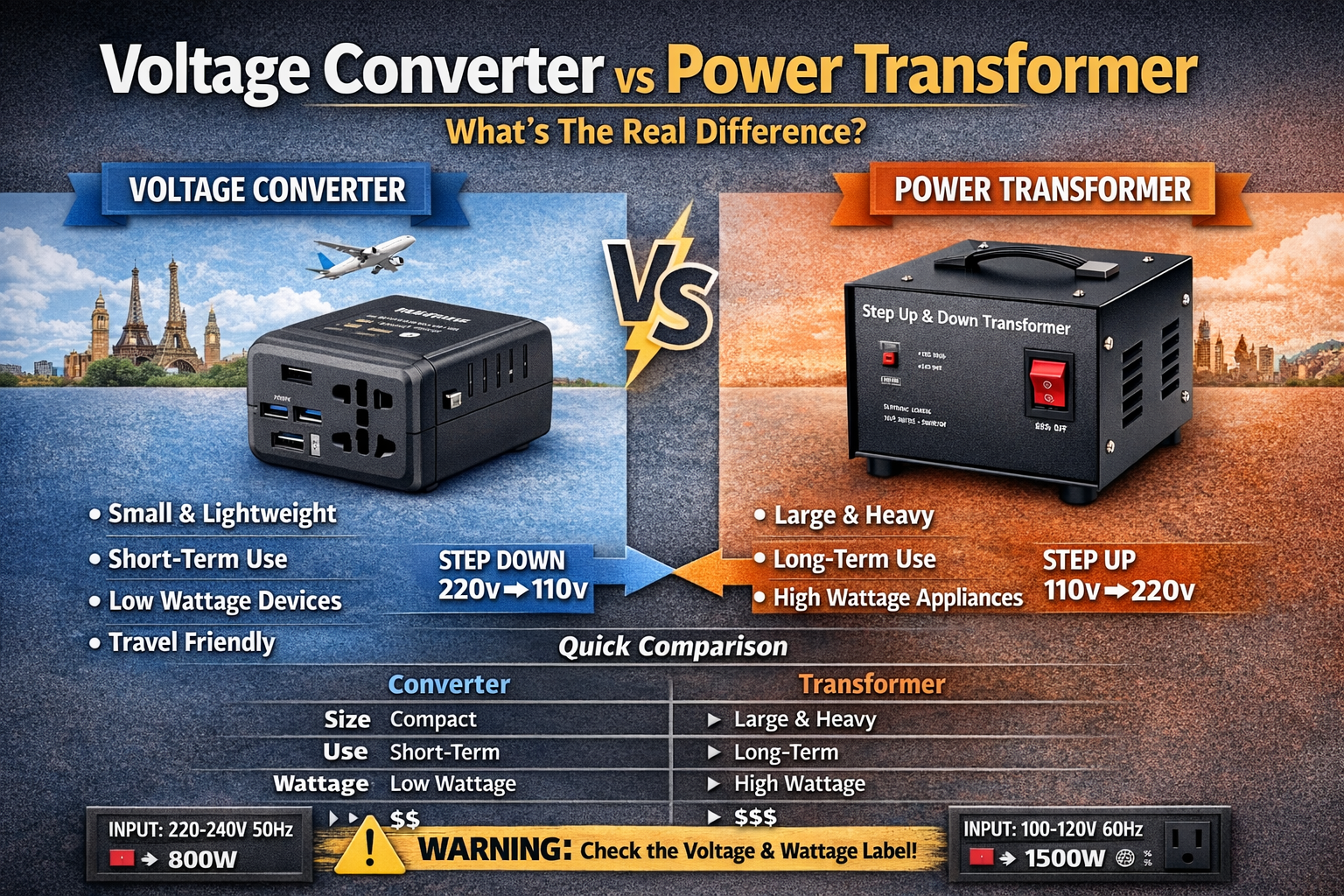
A voltage converter is typically a compact, lightweight device designed for short-term use and usually for low-wattage electronics.
Think:
• Phone chargers
• Laptops
• Electric toothbrushes
• Small grooming tools
Most travel converters are designed for temporary use—like vacations or business trips.
• Smaller and lighter
• Designed for short-term operation
• Often limited to lower wattage
• More affordable
• Best for electronics, not heavy appliances
Some converters are labeled specifically for:
• Hair dryers
• Curling irons
• Travel appliances
But here’s the important part:
Converters are not meant for continuous, heavy-duty use.
Using a small converter for a kitchen appliance like a blender or rice cooker can overload it quickly.
What Is a Power Transformer?
A power transformer (often called a step-up or step-down transformer) is heavier, stronger, and designed for long-term use.
It physically converts voltage using copper windings inside, making it far more stable and reliable for higher wattage devices.
Transformers are ideal for:
• Kitchen appliances
• Coffee machines
• Blenders
• Air fryers
• Microwaves
• Power tools
• Audio equipment
Key Characteristics of Transformers:
• Heavier (sometimes 10–20 lbs or more)
• Designed for continuous operation
• Handle higher wattage safely
• Much more durable
• Ideal for daily household use
If you’re moving to the United States permanently and bringing appliances from overseas, a transformer is almost always the safer option.
Step-Up vs Step-Down: What Does That Mean?
This part confuses a lot of people.
• Step-down transformer: Converts 220V → 110/120V
(Used when bringing European/Asian appliances to the USA)
• Step-up transformer: Converts 110/120V → 220V
(Used when bringing U.S. appliances overseas)
If you’re in the U.S. using a 220V appliance, you need a step-down transformer.
If you’re traveling from the U.S. to Europe and bringing a 120V appliance, you need a step-up transformer.
The Biggest Mistake People Make
They check the plug—but not the voltage label.
A plug adapter only changes the shape of the prongs.
It does NOT change the voltage.
That means your device can still burn out even if it physically fits into the outlet.
Always check the label on your appliance. It will say something like:
• “Input: 100–240V” → This means it’s dual voltage (no converter needed).
• “Input: 220–240V only” → You need a transformer in the U.S.
• “Input: 110–120V only” → You cannot use this directly in Europe without a transformer.
How to Choose the Right Size (Wattage Matters!)
This is critical.
Every appliance has a wattage rating. For example:
• Blender: 600W
• Coffee maker: 1000W
• Air fryer: 1500W
• Hair dryer: 1800W
Your transformer must be rated higher than your appliance wattage.
We recommend adding a 25–50% safety buffer.
Example:
If your air fryer is 1500W, choose at least a 2000W transformer.
Why?
Because appliances with motors or heating elements draw extra power at startup. Without extra capacity, you risk overheating your converter or transformer.
When Should You Use a Voltage Converter?
Use a converter if:
• You’re traveling short-term
• Your device is low wattage
• You don’t plan to run it continuously
• You need something compact and portable
Converters are great for travelers who need flexibility without carrying a heavy transformer.
When Should You Use a Transformer?
Choose a transformer if:
• You’re relocating to the U.S.
• You’re using kitchen appliances
• Your device runs for long periods
• The wattage exceeds 500–800W
• You want long-term reliability
If you’re running a coffee machine every morning or using a European mixer weekly, a transformer is the safer investment.
What About Frequency (50Hz vs 60Hz)?
Most modern electronics aren’t affected by frequency differences.
However:
• Motor-based appliances
• Clocks
• Certain audio equipment
may behave slightly differently between 50Hz and 60Hz systems.
In most household situations, voltage matters more than frequency—but it’s still something to consider for sensitive equipment.
Safety Tips You Should Never Ignore
- Never exceed the wattage rating.
- Never cover a transformer while in use (they need ventilation).
- Avoid using cheap, uncertified products.
- Check for UL or safety certification when buying in the U.S.
- If the unit gets extremely hot, unplug it immediately.
Electrical safety isn’t something to gamble with.
Quick Comparison: Converter vs Transformer
Feature Voltage Converter Power Transformer
Size Small Large & Heavy
Use Time Short-term Long-term
Wattage Lower High
Best For Travel electronics Kitchen appliances
Price Lower Higher
Durability Moderate Very High
Real-Life Example
Let’s say you moved from Germany to the United States and brought:
• A 220V espresso machine (1400W)
• A 220V stand mixer (800W)
Using a small travel converter would likely overheat and fail.
The correct solution? A 2000W step-down transformer that can safely handle both appliances.
That’s the difference between a temporary fix and a long-term solution.
Final Thoughts: Which One Do You Actually Need?
If your device is:
• Small
• Low wattage
• Used occasionally
→ A voltage converter may be enough.
If your device is:
• High wattage
• Used daily
• A kitchen or motor appliance
→ Invest in a proper transformer.
It may cost more upfront—but it protects appliances that cost hundreds (or thousands) of dollars.